

Understanding one of the most overlooked risks in retirement income planning
If you've spent decades saving for retirement, you've probably focused on one number above all others: your average annual return. It's the figure that shows up in projections, performance reports, and financial plans. But there's a lesser-known risk that can matter just as much — and it has nothing to do with how good your average return is. It has to do with the order in which your returns happen.
This is called sequence of returns risk, and understanding it can make the difference between a retirement income plan that lasts and one that runs into trouble years earlier than expected.
The Core Idea
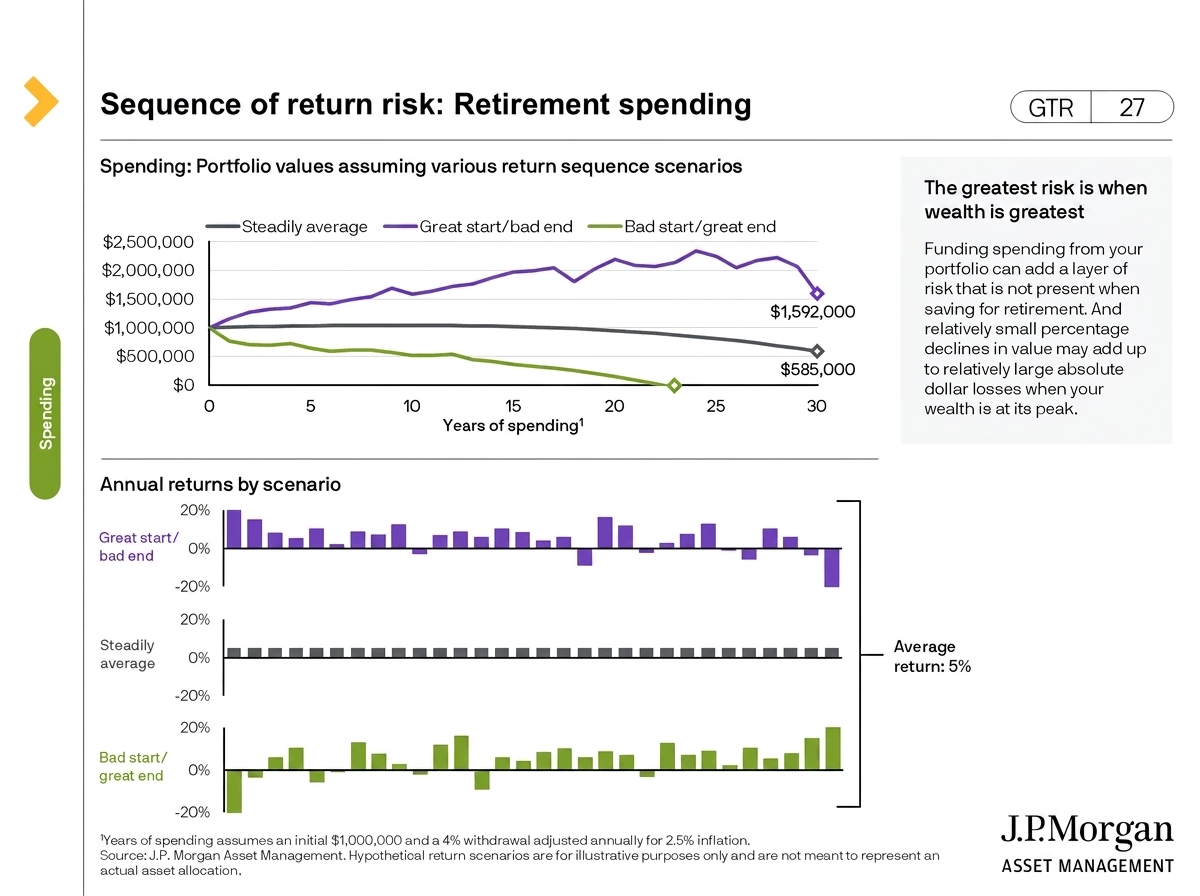
Two retirees can have the exact same average annual return over 20 years and end up in very different financial positions — simply because the good years and bad years happened in a different order.
This might sound counterintuitive. Isn't an average return just an average, regardless of order? Mathematically, yes — but only if no money is being added or withdrawn along the way. Once withdrawals enter the picture, as they do in retirement, timing becomes just as important as the return itself.
A Helpful Way to Picture It
Think of it like the difference between driving through a storm and landing a plane in one.
- While you're still working and saving — you're driving. If you hit a storm (a market downturn) early in the trip, it's an inconvenience. You slow down, but you have time to make up the delay before you arrive.
- Once you're retired and withdrawing income — you're landing. Hitting that same storm right at touchdown is a very different problem. The turbulence at the wrong moment matters far more than turbulence in general.
Why This Happens: Saving vs. Withdrawing
During your working years
A market downturn early in your career may have limited impact. You're still contributing new money, and your portfolio has years — often decades — to recover before you need to draw on it. Time is on your side.
During retirement
A downturn early in retirement may work against you in two ways at once. You're withdrawing income for living expenses at the same time your account value has dropped, which means you're forced to sell more shares to generate the same dollar amount of income. That leaves fewer shares remaining to participate when the market eventually recovers. Even if the market fully bounces back, your portfolio may not — because those losses were already locked in through the shares you were forced to sell.
Same Average Return, Very Different Outcomes
Picture two people who both retire with the same portfolio value and who both average the same annual return over a 20-year retirement.
- Person A experiences stronger returns in the first 10 years of retirement, followed by weaker returns in the second 10.
- Person B experiences weaker returns first, followed by stronger returns later.
Despite averaging the exact same return over the full 20 years, Person A's portfolio holds up well, while Person B's may run out of money years before the end of retirement. The difference isn't the average return — it's the sequence in which the returns arrived relative to the withdrawals being taken.
Why This Matters Most Around Retirement
Sequence of returns risk is generally most dangerous in the years immediately before and after retirement — sometimes called the "retirement red zone." A significant downturn during this window can have an outsized, lasting effect on how long a portfolio lasts, simply because there's less time to recover before withdrawals begin (or while they're already underway).
How This Risk Can Be Managed
The good news: sequence of returns risk is well understood, and there are established strategies to help manage it. A thoughtful retirement income plan may incorporate:
- Flexible, "guardrail" withdrawal strategies — adjusting how much is withdrawn in strong years versus weak years, rather than withdrawing a fixed amount regardless of market conditions.
- Bucket strategies — separating assets earmarked for near-term spending from those invested for long-term growth.
- Diversification and a thoughtful glide path — gradually adjusting the portfolio's risk level as retirement approaches, rather than making an abrupt shift all at once.
A Favorite Approach: The “Spend” Model
One strategy we're especially fond of as clients prepare for retirement is what we call a “spend” model.
With this approach, an account is structured around two components working together: a cash portion, which becomes the source of monthly income, and an investment portfolio, which remains invested for growth. By managing both pieces together — rather than relying on the investment portfolio alone — this approach guards against having to sell off investments to generate income, both heading into and during retirement.
In practice, we maintain a cash reserve covering roughly two to three years of income needs. When the market takes a downturn, income continues to be paid from that cash reserve, so investments aren't sold at depressed prices simply to keep monthly income on track. When the market recovers and the investment portfolio has gains, we then use those gains to replenish the cash portion — restoring the reserve so it's ready for the next downturn.
The result is a plan where reliable monthly income and long-term growth are handled by two different parts of the account, each doing its own job — which is precisely the kind of structure that helps neutralize sequence of returns risk.
| The Takeaway
It's not just about earning a good average return over your lifetime — it's about having a plan that can withstand a poor sequence of returns showing up at the wrong time. Retirement income planning is as much about managing that risk as it is about seeking growth. |
How Montage Wealth Can Help
Sequence of returns risk is one of the key reasons a retirement income plan should be built around more than just an average expected return. We work with clients to structure withdrawal strategies, cash reserves, and portfolio allocations designed to help manage this risk — both heading into retirement and throughout it.
If you're approaching retirement, recently retired, or simply want a second look at how your current plan holds up against this risk, let's talk.
Keep More of What You Work For.
This article is for general informational purposes and is not personalized financial, legal, or tax advice. Please consult with a qualified professional regarding your specific situation. Neither Cetera Wealth Services LLC nor any of its representatives may give legal or tax advice. Securities offered through Cetera Wealth Services, LLC, member FINRA SIPC . Advisory services offered through Cetera Investment Advisers LLC, a registered investment adviser. Cetera is under separate ownership from any other named entity. The return and principal value of stocks fluctuate with changes in market conditions. Shares when sold may be worth more or less than their original cost. All investing involves risk, including the possible loss of principal. There is no assurance that any investment strategy will be successful. Asset allocation cannot eliminate the risk of fluctuating prices and uncertain returns. A diversified portfolio does not assure a profit or protect against loss in a declining market. These examples are hypothetical only, and do not represent the actual performance of any particular investments. Investments in securities do not offer a fixed rate of return. Principal, yield and/or share price will fluctuate with changes in market conditions and when sold or redeemed, you may receive more or less than originally invested. Past performance does not guarantee future results.